Barnakle
Floatation for your phone
The short version
Today's iPhones are waterproof. But they don't float. Barnakle is a MagSafe accessory that fixes that. Useful on a boat. Useful on a paddleboard. Useful anywhere dropping your phone means losing it.
This is a personal project I helped bring to life. Building and designing the product, 40+ prototypes, manufacturing, patent development, and brand.
Most of it was new territory. I came in knowing how to think through problems. CAD, injection moulding, supply chain, Archimedes principle. I figured those out along the way.
Where it stands. Tooling is cut and T1 is in progress. I own the design, the object, and the brand. A co-founder handles business and finance and will carry it from here.
How it started
Last summer I was on a friend's boat near the Golden Gate, watching him lean over the rail for a photo. We got to wondering what happens if he drops it right then.
Every iPhone since the 12 is rated IP68. Sealed against water, good for half an hour at six meters. Great rating. Doesn't stop it sinking.
We turned the problem over on the ride back to the marina. A case works, but you're asking somebody to give up the case they already chose. A pouch works, but you can't use the phone inside one. Then one of us said MagSafe, and the interesting part of the conversation was over.
That night we put a phone in a ziploc, blew it up, floated it in the sink, and let the air out a little at a time to find the minimum that still held it. Surprisingly little. That's the whole product. Enough lift for a phone, in a thing small enough that nobody minds carrying it.

Making it
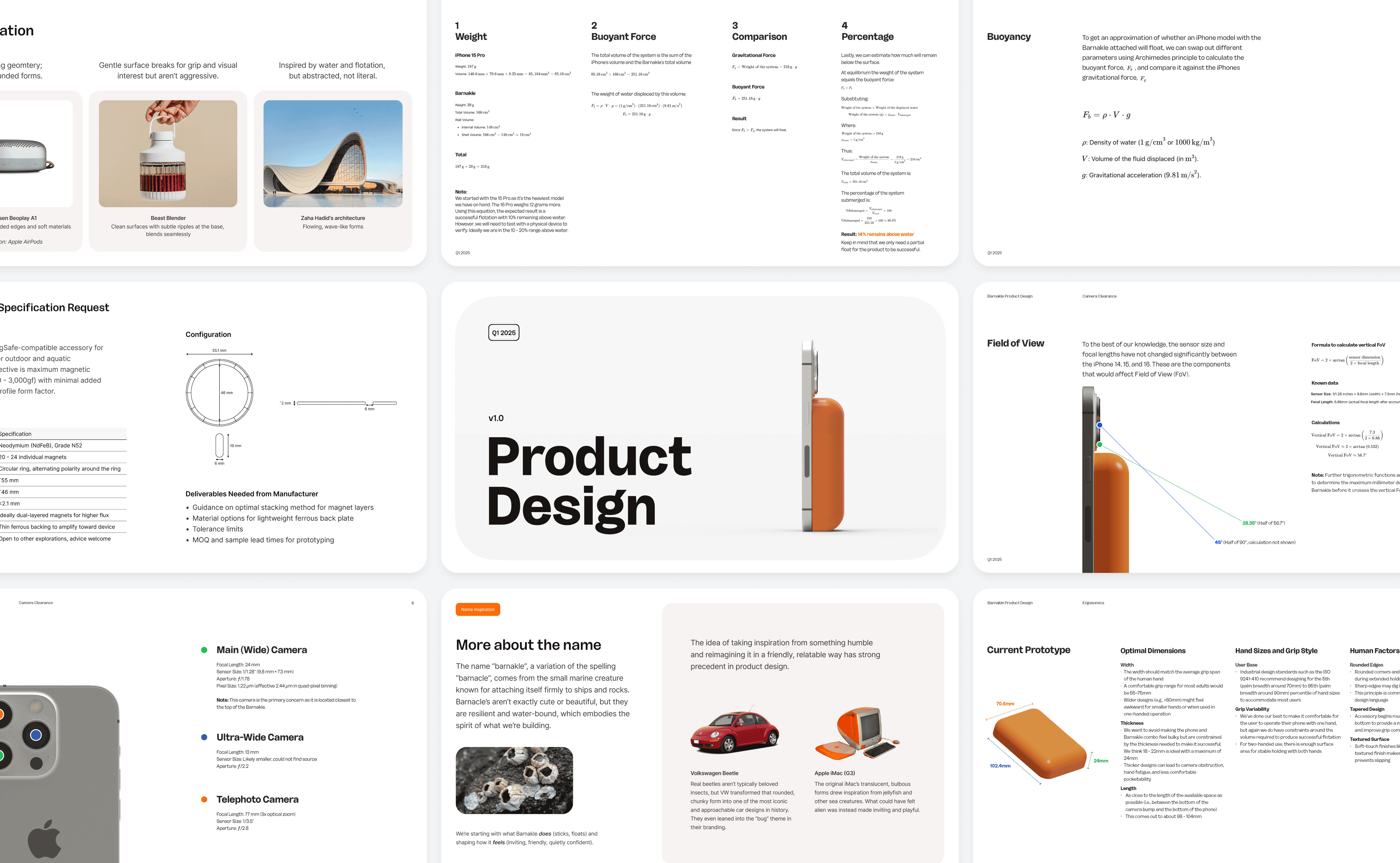
The next several months went into CAD and a 3D printer, next to a box of MagSafe magnet arrays so the prints could hold a real phone. I learned the tools by using them badly, on YouTube's advice, and read my way through the rest.
The sink kept me honest early. Then I wrote the buoyancy math down properly, because at some point somebody else has to be able to check it. Material density came next, because choosing the plastic is choosing how much buoyancy you have before you've designed anything. Then trigonometry, because the main camera governs the shape. Then shore hardness, for a millimeter of silicone on the phone side. The magnet stops it pulling off. The silicone stops it sliding.
About 40 versions went through the same loop. Draw, print, number it, test three things. Does it float, does it foul the camera, does it hold. Whichever failed decided the next version. Two hours a print, and plenty of them differed from the one before by half a millimeter. Fillet radius mattered more than it has any right to.
The constraints arrive as a group. Big enough to float reliably and it creeps into the camera. Grippy enough to feel secure and it's a nuisance to pull off. Everything has to go on and come off in about a second. Any one of those is solvable alone. The design is whatever survives all of them at once, and that's a narrow space.
The other half of the work was deciding what not to learn. I went looking for a patent attorney and a contract manufacturer I could enjoy working with. I picked the factory partly for its posture on IP, because manufacturers who can do this work can also copy it. That took reading directories for longer than I'd like to admit, then a call, then a flight and a tour of the floor.
The factory debate was the wall. The manufacturer wanted 2.6 mm, and they were right to want it, because thicker walls mould more reliably. But every fraction of a millimeter is buoyancy I don't get back. The wall is the product. I said that more times than either of us enjoyed, gave ground somewhere else each time, and we landed on a solution that won on sun, durability and density.
A printed part can be solid and stupid. A moulded one can't. So the internals grew ribs, and the body grew draft angles, slight tapers that let a part leave the steel.
The magnets turned out to be the longer job. Finding a supplier who ships the same array, consistently, for as long as the product exists. A supply chain decision is a design decision. Holding strength is whatever your supplier actually sends.
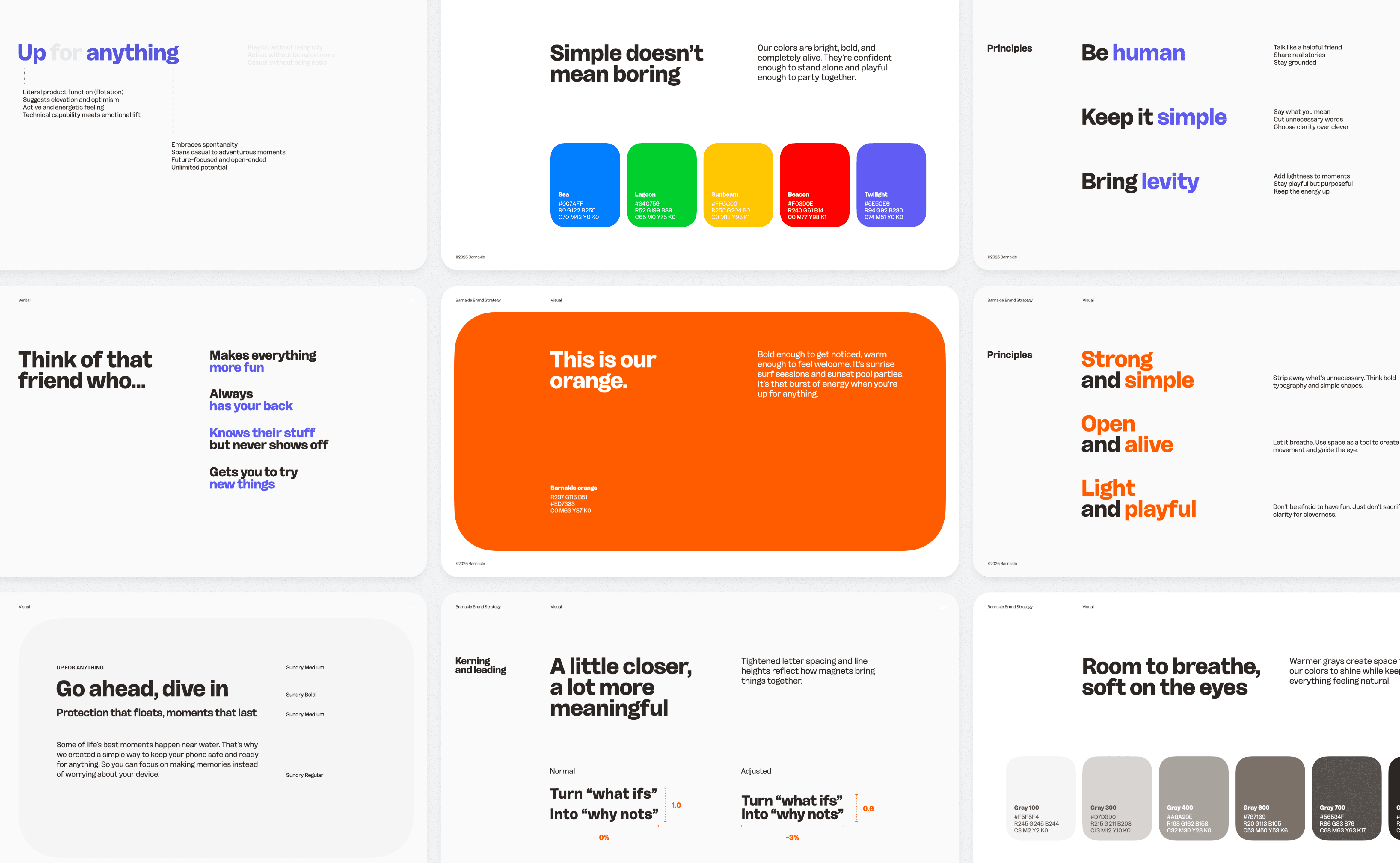
The name took longer than the first prototype. Weeks, and an Apple Notes page with a few hundred dead ideas. The early favorite was PFD, for Phone Flotation Device, off the vest under every boat seat. Too literal. A barnacle attaches to a surface and stays there, which is the product's entire mechanic. The K is deliberate: it trademarks, and it stops the brand being a common noun.
The rest of it
What I got wrong
I trusted MagSafe alone. In testing the Barnakle would slide off the phone, not every angle, not every time, but often enough that a product sold on not losing your phone was failing at the one moment it exists for. Every fix inside the magnet array made something else worse.
So there's a second point of connection now. A silicone tab that folds out of the body and seats in the charging port. It makes one attachment into two, it's optional because it blocks the port, and it tucks into the body when you don't want it. Less elegant than the story I wanted to tell. It also keeps water out of the port, which I didn't design for and won't pretend I did.
The T0 samples then handed me the sequel. The tab came off the tool too loose to trust, so its hardness and structure are being rethought between T0 and T1.
I assumed it could be one product. I designed around the iPhone 15 Pro, which sounds arbitrary and isn't. Densest phone in the range, smallest footprint, so a shell that fits inside its edges fits everything newer. That logic couldn't hide that Base, Pro and Max carry the buoyancy differently. The range needs separate parts, separate tooling, separate pricing, and that arrived after I'd built a go to market around one thing to sell. Better to say which phone a unit fits than to let somebody find out in a lake.
I did the industrial design too early. The structure is sensitive enough that shape decisions kept getting overwritten. I spent a couple of months on form that the physics eventually decided for me.
What I learned
Hardware doesn't let you ship and then learn. Software does. Here you commit and then you find out, and the commit is a large check for a piece of steel. It changes what a decision costs, and therefore how long you're allowed to be undecided.
Deciding what not to learn is the harder half. I taught myself CAD, and I hired an attorney and a factory and then got out of their way. Both were correct and neither is obviously correct in advance. Getting that split right did more for the timeline than any single thing I designed.
Let the physics settle the shape before you style it. Two months of form work were overwritten by numbers that were always going to win.
Where it landed
Behind it now. A test plan run with the factory. Float tests across phone and case combinations, ultraviolet exposure, salt spray, submersion. And a warranty written as the three failures we own. The magnet losing hold in normal use, the unit failing to float to spec, and cracking that isn't from impact. Too broad and you've promised to replace a phone you didn't lose. Too narrow and you've told the buyer, in legal language, that you don't trust your own object.
Trademark granted, utility patent filed, tooling cut, T0 samples in hand, T1 in progress.


Barnakle
Floatation for your phone
The short version
Today's iPhones are waterproof. But they don't float. Barnakle is a MagSafe accessory that fixes that. Useful on a boat. Useful on a paddleboard. Useful anywhere dropping your phone means losing it.
This is a personal project I helped bring to life. Building and designing the product, 40+ prototypes, manufacturing, patent development, and brand.
Most of it was new territory. I came in knowing how to think through problems. CAD, injection moulding, supply chain, Archimedes principle. I figured those out along the way.
Where it stands. Tooling is cut and T1 is in progress. I own the design, the object, and the brand. A co-founder handles business and finance and will carry it from here.
How it started
Last summer I was on a friend's boat near the Golden Gate, watching him lean over the rail for a photo. We got to wondering what happens if he drops it right then.
Every iPhone since the 12 is rated IP68. Sealed against water, good for half an hour at six meters. Great rating. Doesn't stop it sinking.
We turned the problem over on the ride back to the marina. A case works, but you're asking somebody to give up the case they already chose. A pouch works, but you can't use the phone inside one. Then one of us said MagSafe, and the interesting part of the conversation was over.
That night we put a phone in a ziploc, blew it up, floated it in the sink, and let the air out a little at a time to find the minimum that still held it. Surprisingly little. That's the whole product. Enough lift for a phone, in a thing small enough that nobody minds carrying it.
Making it
The next several months went into CAD and a 3D printer, next to a box of MagSafe magnet arrays so the prints could hold a real phone. I learned the tools by using them badly, on YouTube's advice, and read my way through the rest.
The sink kept me honest early. Then I wrote the buoyancy math down properly, because at some point somebody else has to be able to check it. Material density came next, because choosing the plastic is choosing how much buoyancy you have before you've designed anything. Then trigonometry, because the main camera governs the shape. Then shore hardness, for a millimeter of silicone on the phone side. The magnet stops it pulling off. The silicone stops it sliding.
About 40 versions went through the same loop. Draw, print, number it, test three things. Does it float, does it foul the camera, does it hold. Whichever failed decided the next version. Two hours a print, and plenty of them differed from the one before by half a millimeter. Fillet radius mattered more than it has any right to.
The constraints arrive as a group. Big enough to float reliably and it creeps into the camera. Grippy enough to feel secure and it's a nuisance to pull off. Everything has to go on and come off in about a second. Any one of those is solvable alone. The design is whatever survives all of them at once, and that's a narrow space.
The other half of the work was deciding what not to learn. I went looking for a patent attorney and a contract manufacturer I could enjoy working with. I picked the factory partly for its posture on IP, because manufacturers who can do this work can also copy it. That took reading directories for longer than I'd like to admit, then a call, then a flight and a tour of the floor.
The factory debate was the wall. The manufacturer wanted 2.6 mm, and they were right to want it, because thicker walls mould more reliably. But every fraction of a millimeter is buoyancy I don't get back. The wall is the product. I said that more times than either of us enjoyed, gave ground somewhere else each time, and we landed on a solution that won on sun, durability and density.
A printed part can be solid and stupid. A moulded one can't. So the internals grew ribs, and the body grew draft angles, slight tapers that let a part leave the steel.
The magnets turned out to be the longer job. Finding a supplier who ships the same array, consistently, for as long as the product exists. A supply chain decision is a design decision. Holding strength is whatever your supplier actually sends.
The name took longer than the first prototype. Weeks, and an Apple Notes page with a few hundred dead ideas. The early favorite was PFD, for Phone Flotation Device, off the vest under every boat seat. Too literal. A barnacle attaches to a surface and stays there, which is the product's entire mechanic. The K is deliberate: it trademarks, and it stops the brand being a common noun.
The rest of it
What I got wrong
I trusted MagSafe alone. In testing the Barnakle would slide off the phone, not every angle, not every time, but often enough that a product sold on not losing your phone was failing at the one moment it exists for. Every fix inside the magnet array made something else worse.
So there's a second point of connection now. A silicone tab that folds out of the body and seats in the charging port. It makes one attachment into two, it's optional because it blocks the port, and it tucks into the body when you don't want it. Less elegant than the story I wanted to tell. It also keeps water out of the port, which I didn't design for and won't pretend I did.
The T0 samples then handed me the sequel. The tab came off the tool too loose to trust, so its hardness and structure are being rethought between T0 and T1.
I assumed it could be one product. I designed around the iPhone 15 Pro, which sounds arbitrary and isn't. Densest phone in the range, smallest footprint, so a shell that fits inside its edges fits everything newer. That logic couldn't hide that Base, Pro and Max carry the buoyancy differently. The range needs separate parts, separate tooling, separate pricing, and that arrived after I'd built a go to market around one thing to sell. Better to say which phone a unit fits than to let somebody find out in a lake.
I did the industrial design too early. The structure is sensitive enough that shape decisions kept getting overwritten. I spent a couple of months on form that the physics eventually decided for me.
What I learned
Hardware doesn't let you ship and then learn. Software does. Here you commit and then you find out, and the commit is a large check for a piece of steel. It changes what a decision costs, and therefore how long you're allowed to be undecided.
Deciding what not to learn is the harder half. I taught myself CAD, and I hired an attorney and a factory and then got out of their way. Both were correct and neither is obviously correct in advance. Getting that split right did more for the timeline than any single thing I designed.
Let the physics settle the shape before you style it. Two months of form work were overwritten by numbers that were always going to win.
Where it landed
Behind it now. A test plan run with the factory. Float tests across phone and case combinations, ultraviolet exposure, salt spray, submersion. And a warranty written as the three failures we own. The magnet losing hold in normal use, the unit failing to float to spec, and cracking that isn't from impact. Too broad and you've promised to replace a phone you didn't lose. Too narrow and you've told the buyer, in legal language, that you don't trust your own object.
Trademark granted, utility patent filed, tooling cut, T0 samples in hand, T1 in progress.